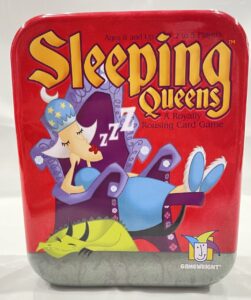
Sleeping Queens: A Kid’s Game that Invites Everyone to the Table
You used to play games all the time, but young kids don’t really mix with board games or card games and you’re raising a toddler (or two!). You’re looking to fill the days with fun activities you and the toddler can do together.
There are the classics of course, like Candyland or Chutes and Ladders, so you set out to teach your little one to play games. And they LOVE IT! Except you don’t, because for an adult playing these games over and over again can be a trying experience.
This is exactly the situation I found myself in years ago, so I started doing some research. Believe it or not, there ARE games you can enjoy with your toddlers and preschoolers. Sleeping Queens isn’t the first game I played with my kids, but once they’d gotten used to a few simpler ones, this is the first one I bought to play together.
How to Play Simplified (Because Sometimes Rules Are Complicated)
In this game’s simplest form, you win by waking up the right number of queens first, specified in the instructions by the number of players.
The queen cards (with green backs) are laid out face down (or “asleep”). The rest of the cards are shuffled and each player is dealt 5 cards. The remainder are set out as a draw pile.
On your turn, you play cards. If you don’t have any picture cards (we’ll get to those in a minute) you simply discard. You can discard a single card, discard a pair of number cards, or discard three or more cards that create an addition equation. The more cards you discard, the more likely you are to get a picture card to use on your next turn.
There are six picture cards with different effects.
Kings wake a queen. Pick a face down queen and put it face up in front of you.
A Knight steals a queen from another player. If that player has a dragon card they can play it to negate the effect of the knight.
Sleeping Potions put another player’s queen back to sleep (face down with the other “sleeping” queens). A magic wand can negate this effect.
The jester is the hardest to remember. Draw one card. If it is a picture card, put it in your hand and take another turn. If it is a number card, count around the circle of players, starting with yourself, and the person you end on gets to wake a queen.
Once you’ve finished your action, you draw until you have five cards in your hand and the next player’s turn begins.
The game ends when one player wakes enough queens!
Barriers to Play and How to Remove Them
The most common struggles in Sleeping Queens are remembering the picture cards and the addition skills.
Simple repetition will help the youngest players learn to remember how each picture card works. As an adult, I kept the rules handy until I could remember the directions for each type of picture card.
If some players haven’t learned to add yet, you can also simplify the win conditions so it’s only by number of queens, instead of by the points on the queen cards. In my family we often do this even when we aren’t playing with younger kids.
And even though matches and addition equations help players be more successful at the game, the youngest players can simply discard one card, as offered in the rules.
If you’d like to give players who still struggle with the optional math skills a chance to play with the matches and addition equations, you can play with every player’s hand face up so other players can help point them out. The little ones will acquire these math skills with time and might start to see patterns in the equations as they play more often (more on this below).
How to Connect While Playing
We Play to Spend Time Together
If you’re looking for a game that helps move players from a one-on-one learning environment to group play, Sleeping Queens makes the whole process an enjoyable experience.
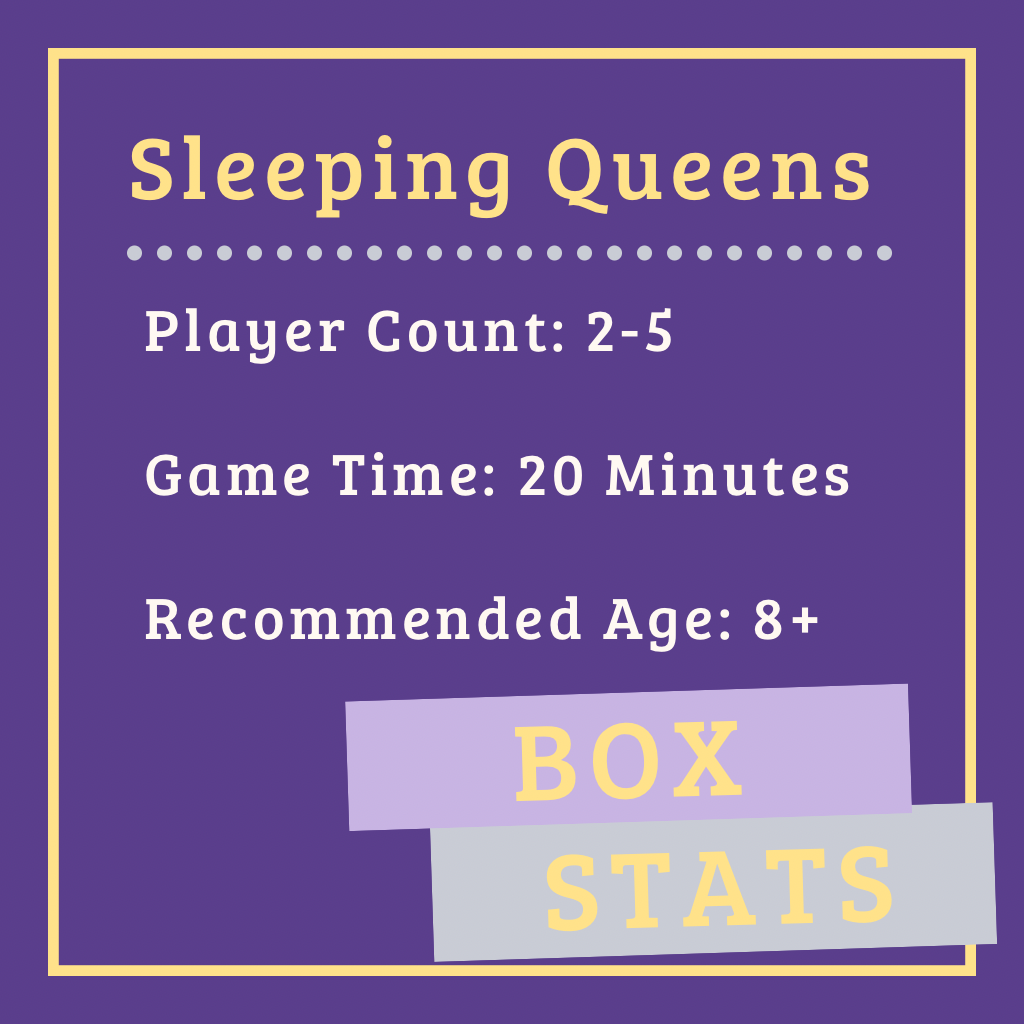
Games with two players create a perfect environment for little ones to learn the game (mine started this one at three or four years old!). Playing together, giving specific attention to one child, and learning the rules and the math skills included in the game all leave precious memories and skills that serve players well. Once that child plays confidently, they can join larger groups to participate in family fun and improve their strategy skills.
Sleeping Queens invites younger players who might be excluded based on their abilities into the group dynamic with just a little practice, without forcing more experienced players into a boring experience. The knights, sleeping potions, and jesters keep more experienced players on their toes, offering greater gameplay interaction so that any player has the chance to pull out a win or prevent another player from waking that final queen.
We Play to Grow, Not Only to Win
Yes, you love that moment when you pull your final queen and win the game. Who doesn’t? But that’s going to happen to one player in every game of Sleeping Queens that you play. The best moments come when players utilize the rules to accomplish something unexpected.
One player might play those jesters over and over, tempting fate and handing the win to another player because they can’t quite comprehend the consequences. But wait until the day it earns them the winning queen!
Or a player holding only number cards, unable to wake or steal any queens, until they realize they can use every single card in their hand in an addition equation.
Or a player wins the game using their knight, stealing a queen from the person with a king in hand, about to draw their final queen on the next turn.
Sleeping queens offers so many opportunities to gain skills in gameplay, math, and other skills that translate well to life. Focusing on those less apparent wins allows players the chance to enjoy that growth through simple fun.
We Help Each Other Learn and Improve
Since this game works well for young players, you can begin by playing with everyone’s hands face up in front of them. This allows more experienced players to help the beginners by pointing out number matches or addition equations.
Then the game scenario isn’t a bunch of experienced players trying to win while the beginner puts cards on the pile, it’s a group of players helping the newest become the kind of player who can compete or change the game.
Meanwhile, playing face up also offers all players the opportunity to practice restraint. Experienced players naturally practice restraint as they play, saving knights or sleeping potions for the right moment, and beginners will be able to observe those choices and learn the strategy of the game in addition to the rules. The experienced players practice kindness and teamwork as well by playing as if they didn’t know what every other player is holding.
Who This Game is For
- Sleeping Queens is a great option for families trying to include toddlers, preschoolers, or early elementary-aged kids in family game nights.
- As intended, elementary-aged kids can play this game independently with other kids.
- It’s perfect for educational settings, like schools or home-schooling, to help kids practice math skills in a fun and engaging way.
Top Learning Skills
Every time you play a game, you have an opportunity to build relationships with other players, but it takes intention to take advantage of that opportunity.
What you’re doing without trying? Building skills that have direct applications to life. Here are the top three skills you build while playing Sleeping Queens.
Number Sense (Educational)
Sleeping Queens helps players consider the relationships between numbers through number recognition and addition.
The game naturally rewards players who practice these skills. For example, if your preschooler recognizes that they hold a pair of the same number, they can discard both cards and draw two new cards, instead of a single card.
Now most adults have a decent sense of numbers, but recognizing those cards in your hand and using them in a game is a little different than adding on paper. The more cards you can use in your addition equations, the better your chances of drawing cards to get you queens.
It’s easy enough to add 1+1=2 or 1+1+2=4, but when you start noticing that you’ve got 5+5=6+4 in your hand then you’re going to be much more successful in Sleeping Queens.
Risk Assessment (Executive)
This comes into play most clearly with the Jester cards because the result of the card is based on whatever card you draw from the deck. You can easily give another player the win if you play a Jester at the wrong moment.
But that isn’t the only way this skill comes into play. You might choose between waking another queen or trying to steal one from the player in the lead and taking the chance that they block your card. You might choose between putting another player’s queen back to sleep or discarding an equation with several number cards, giving you the chance to get some useful cards.
Your choices in Sleeping Queens can win you the game, win someone else the game, or prolong it so you still have the opportunity to win. You’ll need to weigh your options carefully before you play your cards.
Frustration Tolerance (Socio-Emotional)
Sure, you could play a game of Sleeping Queens where you always have a card in your hand that will get you a queen, but it’s not very likely. Instead, you’ll face obstacles like a handful of number cards you’re struggling to discard or every knight or sleeping potion you play is blocked.
Each of these moments is a chance to practice putting aside frustration and continuing to play the game. To make it through a game of Sleeping Queens you’ll need to manage all the frustrating moments and keep going until one player (hopefully you!) gets the winning number of queens.
Kids’ Fun for Everyone with Sleeping Queens
It may be a kid’s game, but Sleeping Queens blends simplicity, strategy, and educational skills to create a game worth any player’s time. Players of all ages and experience can enjoy this beginner friendly card game. If you’re looking for a game that’s flexible in player count, experience level, and full of fun then Sleeping Queens checks all the boxes.
If You Liked This Game
If you loved Sleeping Queens and you’re looking for a new challenge, Rat a Tat Cat has simple rules and will give your memory a workout. For a game with similar mechanics aimed at a more mature group of players, try Unstable Unicorns for more chaos and more sabotage.
If You Struggled With This Game
To anyone struggling with Sleeping Queens, I’d recommend trying Uno. It’s similar in play, with number cards and a few special cards, but simpler.
Helpful Resources
- Try Best Board Games and Card Games for Toddlers and Preschoolers if you’re looking for games for kids ages 2-5.
- Struggling with that frustration tolerance? Read How to Help Your Sore Loser Enjoy the Game for some tips.